Leprechauns, figures from Irish folklore, are often depicted guarding hidden treasure, notably pots of gold. These agile, solitary fairies or goblins are known for their mischievous nature and elusiveness.

What are Leprechauns?
Leprechauns are deeply embedded within Irish folklore, traditionally portrayed as diminutive, male fairies or goblins. Often described as incredibly agile, they are primarily known as the guardians of hidden treasure – most famously, a pot of gold concealed at the rainbow’s end. These solitary creatures aren’t inherently malicious, but possess a penchant for mischief, often playing tricks on unsuspecting humans.
Historically, capturing a leprechaun was believed to grant the captor three wishes, though these beings are notoriously difficult to catch due to their cunning and quickness. They are often depicted as skilled craftsmen, particularly cobblers, constantly hammering away at tiny shoes. The name “leprechaun” itself is thought to derive from “Lugh-chromain,” a corruption of the name Lugh Lamhfada, a powerful figure in Celtic mythology.
Their existence is interwoven with the broader realm of the “Good People” (Sidhe), highlighting their place within a complex system of Irish supernatural beliefs. Finding detailed leprechaun stories in PDF format allows for deeper exploration of these captivating figures.
The Enduring Appeal of Leprechaun Folklore
The persistent fascination with leprechaun folklore stems from a captivating blend of mystery, mischief, and the allure of hidden treasure. These figures embody a sense of untamed magic, representing a connection to Ireland’s ancient Celtic past and a world beyond the mundane. The promise of a pot of gold fuels the imagination, symbolizing luck, prosperity, and the possibility of extraordinary fortune.

Leprechauns’ trickster nature adds another layer of appeal, offering entertaining tales of wit and cunning. Their elusiveness and the challenge of capturing one resonate with a universal desire for adventure and the thrill of the chase. Modern media, like Disney’s depictions, have further cemented their place in popular culture, though often simplifying the original folklore.
Accessing leprechaun stories in PDF format provides a valuable opportunity to delve into the authentic narratives and understand the deeper cultural significance of these enchanting beings, preserving the richness of Irish tradition.
Scope of this Article: Leprechaun Stories in PDF Format
This article will explore the captivating world of leprechauns, focusing on accessing traditional and contemporary tales through readily available PDF resources. We will navigate the digital landscape to uncover a wealth of leprechaun stories, ranging from classic folklore to modern adaptations suitable for all ages. The primary aim is to provide a curated guide to finding authentic Irish narratives in a convenient, downloadable format.
We will examine sources offering educational PDFs designed for children, fostering an appreciation for Irish culture and mythology. Furthermore, the article will touch upon the evolution of leprechaun representation, acknowledging the influence of popular media while emphasizing the importance of preserving original folklore.
Ultimately, this serves as a practical resource for anyone seeking to immerse themselves in the enchanting realm of leprechauns through the accessible medium of PDF storytelling, ensuring these tales endure for generations.

Historical Origins of Leprechauns
Leprechaun origins trace back to ancient Celtic mythology, a rich tapestry of beliefs and traditions shaping Ireland’s cultural landscape, with unique roles within it.
Celtic Mythology and Early Representations
Celtic mythology, a complex system of beliefs predating written records in Ireland, provides the foundational context for understanding the emergence of figures like the leprechaun. This mythology is characterized by a vast pantheon of gods, goddesses, and various supernatural beings inhabiting a world closely intertwined with the natural landscape. Early representations of these beings weren’t always clearly defined as “leprechauns” as we know them today; instead, they existed as a broader category of diminutive, often mischievous, spirits.
These early spirits were frequently associated with specific locations – hills, forests, and underground dwellings – and were believed to possess knowledge of hidden treasures. The Celts held a deep respect, and often a degree of fear, for these entities, recognizing their power and influence over the mortal realm. Stories passed down through oral tradition depicted interactions with these beings, often involving trickery, bargains, and warnings against disrespecting their domains. The evolution from these generalized spirits to the more specific figure of the leprechaun was a gradual process, influenced by centuries of storytelling and cultural shifts.
Lugh Lamhfada and the Evolution to Leprechaun
The figure of Lugh Lamhfada, a prominent deity in Irish mythology, is surprisingly linked to the eventual development of the leprechaun archetype. Lugh, a god of many skills – arts, crafts, and the sun – was initially portrayed as a powerful and versatile figure, even the father of the legendary hero Cu Chulainn. However, over time, the perception of Lugh underwent a transformation. His all-powerful image gradually diminished, giving rise to a different iteration: Lugh-chromain, meaning “Lugh of the crooked back” or “stooping Lugh.”
This shift represents a crucial step in the evolution towards the leprechaun. Lugh-chromain was depicted as a fairy craftsman, a skilled artisan but diminished in stature and power compared to his earlier incarnation. The nickname eventually became corrupted, morphing into “Leprechaun” through linguistic changes and repeated retelling of stories. This transition illustrates how mythological figures can evolve and adapt over centuries, reflecting changing cultural values and beliefs. The craftsman aspect remained central, linking the leprechaun to shoemaking and hidden treasures.
Leprechauns as Spirits: Connection to Elves
Celtic literature provides compelling evidence suggesting that leprechauns, and similar dwarfish beings within folklore, aren’t remnants of a folk memory concerning a real, diminutive human race. Instead, they are fundamentally spirits, akin to elves found in other European traditions. This perspective, supported by numerous scholars and folklorists – including the renowned W.B. Yeats – positions leprechauns within a broader context of supernatural entities inhabiting the Irish landscape.
The understanding of leprechauns as spirits highlights their connection to the “Good People” (Sidhe), the fairy folk of Irish mythology. This classification explains their elusive nature, their ability to vanish, and their penchant for trickery. Like elves, they exist in a realm alongside our own, occasionally interacting with humans, often with mischievous intent. This spiritual nature also accounts for their protective guarding of treasure; it’s not merely material wealth they defend, but something intrinsically tied to their otherworldly existence.

Leprechaun Characteristics & Appearance
Leprechauns are typically portrayed as small, agile male fairies or goblins, living solitary lives and often engaging in mischief. They are notoriously difficult to capture.
Physical Description: Size, Clothing, and Features
Descriptions of leprechauns consistently portray them as diminutive in stature, generally small men. While specific heights vary across tales, they are always significantly smaller than humans, contributing to the challenge of capturing them. Their agility is frequently emphasized, allowing them to evade capture with ease.
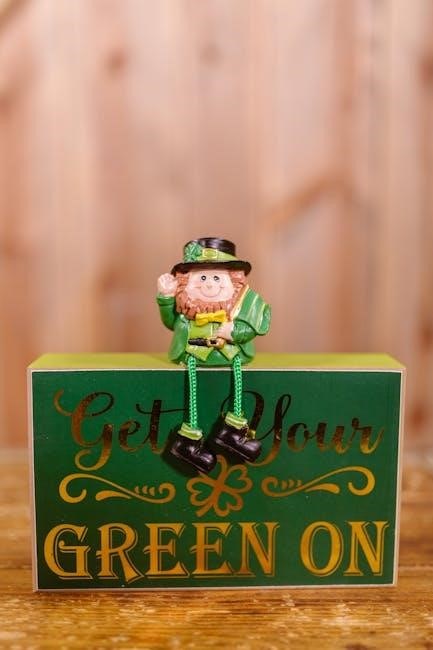
Traditionally, leprechauns are depicted wearing green coats, waistcoats, and hats, though older stories suggest red was a more common color. They are often shown as cobblers, diligently working on shoes, and are frequently associated with tools of the trade. Their appearance is often described as wizened or aged, with beards and sometimes a somewhat gruff or mischievous expression.
Beyond clothing, details about their features are less consistent, but they are generally considered to be male figures. The emphasis is less on precise physical details and more on their overall impression as small, quick, and somewhat eccentric beings, deeply connected to the natural world and their craft.
Solitary Nature and Mischief-Making
Leprechauns are overwhelmingly described as solitary creatures, preferring to live alone rather than in groups or communities. This isolation contributes to their enigmatic nature and makes encounters with them rare and unpredictable. They aren’t typically portrayed as actively seeking out human interaction, but rather as avoiding it whenever possible.
However, their solitude doesn’t equate to harmlessness. Leprechauns are renowned for their mischievous tendencies, often playing pranks on humans or leading them astray. This mischief isn’t usually malicious, but rather a playful, albeit sometimes frustrating, expression of their independent spirit. They delight in trickery and enjoy outsmarting those who cross their path.
This penchant for mischief is a core element of their folklore, adding to their allure and making them fascinating, if somewhat untrustworthy, figures. Their solitary existence seems to fuel their playful, and occasionally troublesome, interactions with the human world.
The Leprechaun’s Craftsmanship
A defining characteristic of leprechauns is their exceptional skill as craftsmen, particularly in shoemaking. They are traditionally depicted as incredibly talented cobblers, diligently crafting shoes for the fairies – a task that explains their constant need to hoard gold to pay for materials and services. This dedication to their craft isn’t merely a profession; it’s deeply ingrained in their identity.
Beyond shoemaking, leprechauns are believed to possess a broader range of artisanal skills, encompassing various arts and crafts. Their connection to Lugh Lamhfada, a deity associated with skill and the arts, reinforces this notion of inherent craftsmanship. This talent extends to creating magical items and concealing treasures.
The quality of their work is said to be unparalleled, reflecting their meticulous nature and dedication to perfection. Their craftsmanship is not just about creating objects; it’s about imbuing them with a touch of magic and mystery.

The Pot of Gold and Hidden Treasure
Leprechauns are famously associated with guarding hidden pots of gold, a symbol of their wealth and a central element in many Irish folklore tales.
The Significance of the Pot of Gold
The pot of gold isn’t merely a symbol of wealth in leprechaun lore; it represents something far deeper rooted in Irish history and mythology. It’s believed the treasure isn’t simply accumulated riches, but often represents something lost or hidden – perhaps a family’s fortune, a nation’s heritage, or even a piece of the ancient Celtic past. The leprechaun’s fierce protection of this gold isn’t greed, but a guardianship of something intrinsically valuable.
Stories often depict the gold as being magically replenished, making it an unattainable prize for humans. This reinforces the idea that the true value isn’t the gold itself, but the pursuit and the lessons learned in attempting to obtain it. The pot of gold serves as a metaphor for dreams, ambitions, and the often-elusive nature of happiness. It’s a constant reminder that some treasures are best left undisturbed, and that the journey is often more rewarding than the destination. The enduring image continues to captivate imaginations across generations.
Guarding Treasure: Why Leprechauns are Protective
Leprechauns aren’t simply avaricious creatures hoarding gold for personal gain; their protectiveness stems from a deeper sense of responsibility and connection to the treasure they guard. The gold isn’t viewed as mere currency, but as something intrinsically linked to the land, to ancient history, and perhaps even to the leprechaun’s very existence. Losing the gold would represent a loss of identity and a disruption of the natural order.
Their solitary nature further fuels this protectiveness. Lacking a community or family to share with, the treasure becomes their sole focus and purpose. The difficulty in capturing a leprechaun isn’t just due to their agility and trickery, but also their unwavering dedication to their task. They are masters of deception, employing illusions and misdirection to deter anyone who attempts to steal their precious hoard, ensuring its safety for eternity.
Attempts to Capture a Leprechaun for Gold
Throughout Irish folklore, numerous tales detail attempts to capture leprechauns and claim their hidden gold. These stories consistently emphasize the extreme difficulty of such endeavors, highlighting the leprechaun’s cunning and agility. Capturing one requires constant vigilance, as they are notorious for exploiting any lapse in attention. Often, the would-be captor is tricked or distracted, losing sight of the leprechaun and their treasure.
A common tactic involves focusing on the leprechaun’s distraction – typically, their shoemaking – while attempting to seize them. However, leprechauns are masters of misdirection, often creating multiple illusions or vanishing altogether. Even if momentarily caught, they are skilled negotiators, offering wishes or riddles in exchange for their freedom, rarely relinquishing their gold easily. These tales serve as cautionary narratives, emphasizing the futility of greed and the respect due to the “Good People.”
Leprechaun Folklore and Stories
Leprechaun tales commonly feature trickery, wit, and interactions with the Sidhe (the “Good People”). These narratives often explore themes of greed, luck, and the consequences of disrespecting fairy folk.
Common Themes in Leprechaun Tales
Leprechaun stories consistently revolve around several captivating themes, deeply rooted in Irish folklore and tradition. The pursuit of hidden treasure, particularly the iconic pot of gold, is a central motif, driving many narratives and representing both material wealth and elusive fortune. However, the tales rarely focus solely on the gold itself; instead, they emphasize the challenges and moral implications of seeking it.
Trickery and deception are also paramount. Leprechauns are masters of illusion and misdirection, often attempting to outsmart humans who try to capture them. These encounters frequently test the wit and resourcefulness of the characters involved, highlighting the importance of cleverness over brute force. The stories often serve as cautionary tales, warning against greed and the dangers of trusting appearances.
Furthermore, a recurring theme is the delicate balance between the human world and the realm of the Sidhe, or “Good People.” Leprechauns, as members of this fairy realm, embody the unpredictable and often capricious nature of the supernatural. Respect for these beings, and adherence to traditional customs, is frequently portrayed as essential for avoiding misfortune. Ultimately, these tales offer a glimpse into a world where magic is real, and the consequences of one’s actions can be profound.
The Importance of Trickery and Wit
Leprechaun folklore consistently emphasizes the crucial role of trickery and wit, not merely as plot devices, but as fundamental aspects of the creatures themselves and the narratives surrounding them. Leprechauns aren’t overcome by strength or direct confrontation; instead, humans attempting to capture them – and their gold – must rely on cunning and cleverness to succeed, often with limited results.
This focus highlights a cultural value placed on intelligence and resourcefulness. Stories aren’t about overpowering the fairy folk, but about outsmarting them, a task rarely achieved. The leprechaun’s own trickery isn’t malicious, but a defense mechanism, a way to protect their treasure and maintain their freedom. It’s a game of wits, where the leprechaun holds a significant advantage.
The tales implicitly suggest that brute force is ineffective against the supernatural. Success depends on exploiting loopholes, recognizing illusions, and possessing a sharp mind. This theme reinforces the idea that true power lies not in physical dominance, but in intellectual agility and the ability to anticipate and counter deception. The stories celebrate cleverness as a virtue, and warn against naiveté.
Leprechauns and the “Good People” (Sidhe)
Leprechauns are firmly categorized within the broader realm of the Sidhe, often anglicized as “the Good People,” a collective term for the supernatural inhabitants of Irish folklore. However, their position within this hierarchy is somewhat unique. While all Sidhe possess magical abilities and inhabit a world parallel to our own, leprechauns are generally considered a lower order, more solitary and less powerful than other fairy folk.
This classification explains their focus on material wealth – guarding treasure is a task suited to their capabilities, rather than wielding grand magical influence. The Sidhe encompass a vast range of beings, from benevolent protectors to mischievous tricksters, and leprechauns fall more towards the latter end of that spectrum. They are not inherently evil, but their self-preservation and love of pranks often lead to conflict with humans.
Understanding this connection to the Sidhe is crucial for interpreting leprechaun folklore. It emphasizes that they are not simply goblins or dwarves, but integral parts of a complex supernatural system, governed by ancient rules and traditions. Respect, caution, and a degree of deference are advised when encountering any member of the Sidhe, including the elusive leprechaun.

Leprechauns in Modern Media & PDF Resources
Digital archives offer numerous leprechaun stories in PDF format, alongside resources for children. Disney’s portrayal significantly shaped modern perceptions of these mythical creatures.
Disney’s Influence on Leprechaun Representation
Disney’s depiction of leprechauns, while immensely popular, significantly altered the traditional folklore. The archivist of the National Folklore Archive expressed concern that Disney’s portrayal would lead to a caricature of these figures, attempting to persuade the studio to focus on other folkloric creatures. Despite these efforts, Disney proceeded with their vision, solidifying a specific image of leprechauns in the public consciousness.
This representation often emphasizes a jovial, somewhat clumsy character, a departure from the more ambiguous and potentially dangerous nature described in older tales. While introducing leprechauns to a wider audience, this Disneyfication arguably simplified the complexities of their origins and characteristics. Consequently, many modern interpretations draw heavily from this popularized image, influencing how leprechauns are perceived and portrayed in various media, including the availability of leprechaun stories in PDF format geared towards children.
The impact extends to how these stories are presented, often focusing on lighthearted adventures rather than the trickery and potential for mischief inherent in traditional lore. Finding authentic, nuanced leprechaun stories in PDF form requires seeking out resources that delve deeper into the original Celtic mythology.
Finding Leprechaun Stories in PDF Format Online
Locating authentic leprechaun stories in PDF format requires navigating a diverse online landscape. Numerous websites offer collections of Irish folklore, often including downloadable tales featuring these mischievous creatures. Project Gutenberg and similar digital libraries can be valuable resources, though finding specifically curated leprechaun content may require targeted searches.
Educational websites and online archives dedicated to Celtic mythology frequently provide PDF versions of traditional stories, offering a more scholarly approach. However, be mindful of the source’s credibility and potential biases, particularly when encountering modernized or Disney-influenced retellings. A focused search using keywords like “Irish folklore PDF,” “leprechaun tales PDF,” or “Celtic myths PDF” will yield relevant results.
Furthermore, many museums and cultural institutions offer downloadable resources, including leprechaun stories, as part of their educational outreach. Always verify the copyright status before distributing or reproducing any PDF content found online, ensuring responsible access to these captivating tales.

Educational Resources: Leprechaun Folklore for Children (PDFs)
A wealth of leprechaun folklore resources in PDF format are specifically designed for children, making them ideal for educational purposes. Websites dedicated to Irish culture and heritage often provide free downloadable storybooks, coloring pages, and activity sheets centered around leprechaun tales. These resources typically present the folklore in an age-appropriate manner, emphasizing the trickery, wit, and cultural significance of these mythical beings.
Teachers and parents can find curated collections of leprechaun-themed PDFs on educational platforms like Teachers Pay Teachers or through school library databases. These materials often include comprehension questions, vocabulary exercises, and creative writing prompts to enhance learning. When selecting resources, prioritize those that accurately reflect traditional Irish folklore, avoiding overly commercialized or simplified versions.
Remember to preview any PDF before sharing it with children to ensure its suitability and alignment with educational goals. These resources offer a fun and engaging way to introduce young learners to Irish culture and the enduring magic of leprechaun stories.